
Learn traditional birch bark crafts and rattan basketry, including making a pack basket.
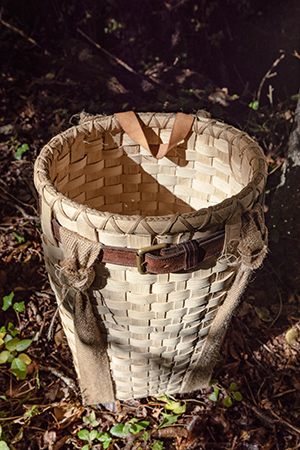
Birch bark has been used for centuries across the northern forests of Europe, Asia and North America to make everything from simple containers to intricate woven objects. Rattan, which originates in tropical regions, is another remarkably versatile natural material, valued for its strength and flexibility in basket making.
In this six-day course, you’ll learn to work with both materials, building practical skills through a series of projects that introduce different methods of preparing, shaping, and constructing useful objects.
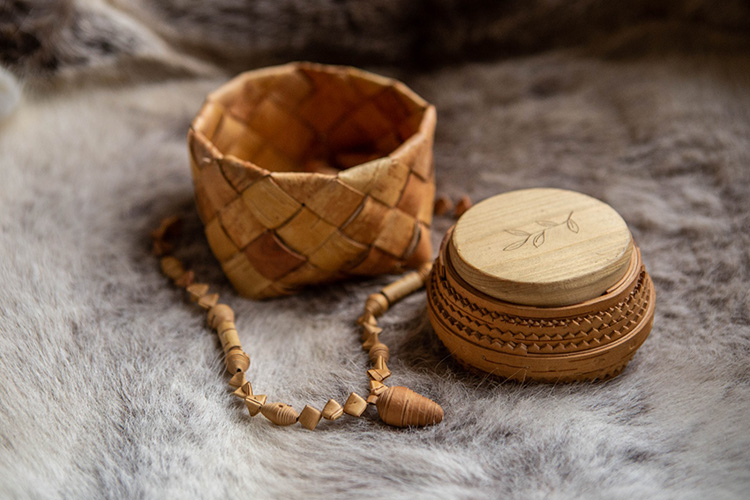
We begin with birch bark, learning how to select, prepare and work with this distinctive material. Starting with smaller projects, you’ll become familiar with its properties and the techniques for shaping and weaving it. You’ll then progress to making a traditional Tavlinka, a small decorative birch bark container with a wooden base and lid.
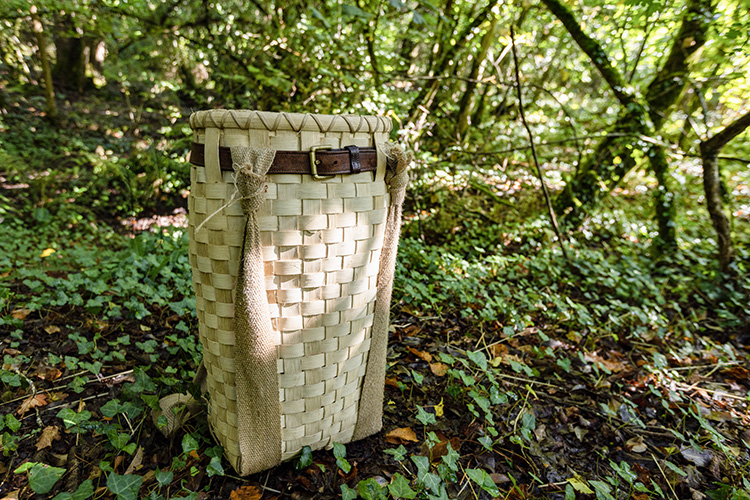
During the second part of the week, we’ll turn our attention to basketry, using rattan to construct a traditional-style pack basket. You’ll learn how to prepare the material, weave the body of the basket and finish it with a strong rim, creating a practical piece of equipment that you can take home and put to use.
Throughout the course, visiting instructor Siegurd van Leusen of Bushcraft Nederland will guide you, sharing his knowledge of these traditional crafts and the techniques involved in working with natural materials. Siegurd will be supported by Frontier Bushcraft course assistants throughout this course, with our usual base camp set-up.
The Course Programme
Over six days, you’ll work on a series of traditional craft projects, starting with the fundamentals of working with birch bark and progressing to two more substantial pieces: a traditional Tavlinka container and a woven rattan pack basket.
The course is divided into three parts, allowing you to build familiarity with the materials and techniques before applying them to increasingly involved projects.
Part 1: Working with Birch Bark
Birch bark is a remarkably versatile material. Strong, flexible, and naturally water-resistant, it has long been used to make containers, baskets, and a wide variety of everyday objects across northern Europe, Asia, and North America.
In this part of the course, you’ll quickly build a solid foundation in working with birch bark by starting with some simple projects.
These may include making a sheath for a small knife or other tool, decorative items such as a star or necklace components, and a small woven basket. If time allows, we can also make a small cylindrical matchbox.
These introductory projects will help you become familiar with cutting, folding, shaping and weaving birch bark, providing a foundation for the more involved work that follows.
Part 2: Making a Traditional Birch Bark Tavlinka
This is a beautiful and unique craft. This is an opportunity to learn a distinctive form of birch bark craftsmanship, combining carefully prepared bark with wooden components to create a fitted, lidded container.
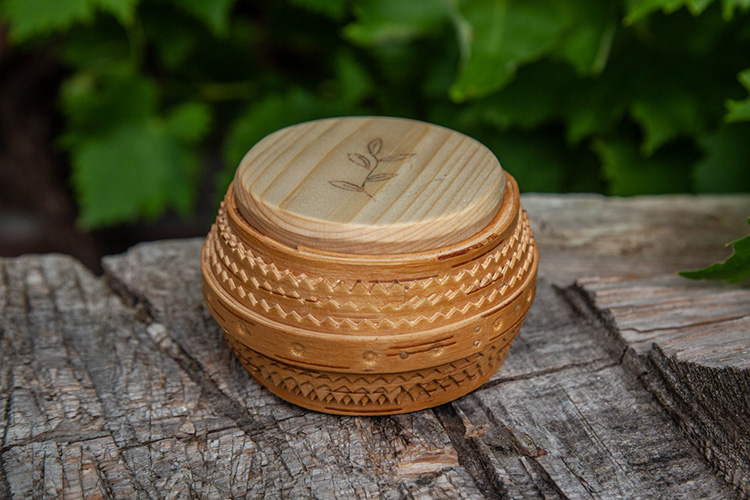
The Tavlinka is a small, round birch bark container traditionally used for storing small personal items, including jewellery or tobacco.
Making a jewellery pot from birch bark is rare these days and is practised only in remote areas of Russia where old traditions still live on. These days, the only place where you might find these kinds of containers is somewhere in a small, remote Loppis (second-hand shop in Scandinavia) … if you are lucky. So, learning to make your own is worthwhile for multiple reasons.
You’ll learn how to prepare and cut the bark, form the body of the container, make wooden pegs, and shape the wooden base and lid.
The finished Tavlinka is both a useful small container and an attractive example of traditional craftsmanship. Its decorative patterns and careful construction make it a particularly satisfying project.
Part 3: Weaving a Traditional Pack Basket
Making baskets is perhaps one of the oldest and most widespread crafts in human history. From a wide variety of natural materials such as grasses, inner bark, leaves, bark, and pine needles, people have made baskets and other objects by hand through braiding, matting, twining, or coiling.
In the final part of the course, you’ll undertake the week’s largest project: making a traditional-style pack basket from rattan.
The pack basket originated with Native Americans. These baskets are sturdy, practical containers designed to be carried on the back. Fishermen, trappers, farmers, and hunters used them. Originally, they used black ash or willow. We use rattan because it has similar properties and is a strong, flexible material well suited to basket weaving.
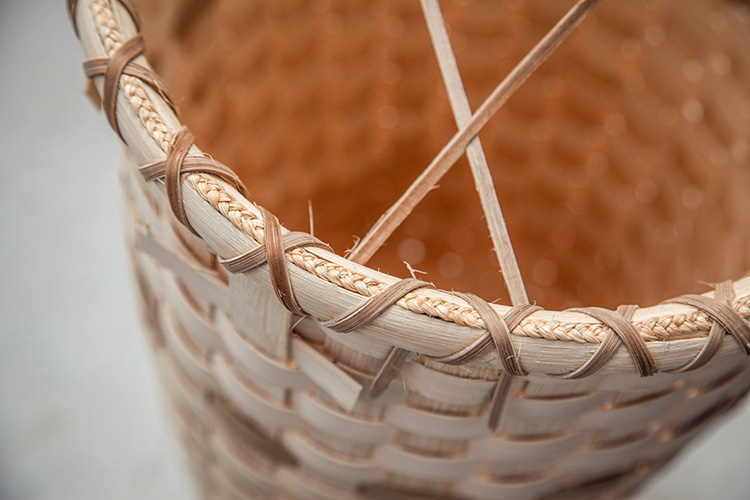
Starting with material preparation, you’ll learn to construct the basket, weave its body, and form a strong, reinforced rim. You’ll also work on the finishing details, including the shoulder straps and fastening, to produce a basket you can carry and use.
This substantial project brings together a range of basket-making techniques and helps you develop your accuracy and consistency as you work.
By the end of the course, you’ll have gained practical experience of several traditional construction methods and made a collection of objects to take home, including your own pack basket.
Detail of What You Will Learn: The Syllabus
- The traditional uses of birch bark for containers and other craftwork
- How birch bark is harvested
- Examples of crafts where birch bark has been used
- Selecting suitable birch bark and understanding its properties
- How birch bark is prepared for use
- Cutting, folding and shaping bark for different projects
- Preparing birch bark strips for weaving
- Making a simple sheath for a small knife or tool
- Creating small decorative items from birch bark
- Weaving a small basket using the crossway method
- Preparing birch bark for a fitted, lidded container
- Cutting and arranging bark strips for the container body
- Forming and assembling the Tavlinka
- Making wooden pegs for the construction
- Cutting and shaping the wooden base and lid
- Understanding how the different components fit together
- Decorative details and finishing techniques
- The history and practical uses of traditional pack baskets
- Understanding the properties of rattan and its suitability for basketry
- Selecting and preparing rattan for weaving
- Preparing the components needed for the basket
- Weaving techniques used to construct the basket body
- Maintaining a consistent shape and an even weave
- Constructing and securing a strong, reinforced rim
- Making and fitting the shoulder straps and fastening
- Finishing and oiling the completed basket
All the Other Details You Need to Know…
Equipment
Specialist tools are provided for use during the course but if you have your own woodcarving knife such as the Mora 106, Mora 120, or similiar Sjöjd knife, please bring it.
A full kit-list is available here. The kit-list will also be e-mailed to you after your booking has been accepted.
Accommodation and Venue
This course will be entirely outdoors, run from an expedition-style base-camp. Please bring personal camping equipment as per the course kit list.
Food
All food is provided. If you have special dietary requirements there is the opportunity to tell us about this during the booking process.
Experience Required
You do not need to have previous experience of bushcraft or camping to attend this course but some knowledge of basic knife safety and simple knife techniques would be useful. The course will teach you the skills you need.
Availability and Booking: Crafts with Siegurd
Duration: 6 days
Price: £867 including VAT.
Deposit: 25% on booking.
Suitability: 18 years & above.
Course size: 12 participants (maximum).
Location: East Sussex.
Course Meeting Time: 16:00 Day 1.
Course Finish Time: 16:00 Day 8.
Course Leader: Siegurd van Leusen
Course Dates:

Back up to the bushcraft courses page.