
Recently my family and I had a great day at the Wildfowl & Wetlands Trust site in Barnes, London.
I was already looking forward to a nice day out with my kids, wife, aunt and uncle but was pleasantly surprised to find some wilderness living inspiration alongside all of the great nature-based activities and interest on offer.
The site is split into zones focusing on ecology and native peoples from different parts of the world.
Two things caught my eye – a yurt which sits in its own little field and looks like it is used to host groups inside and an impressive log cabin in the ‘Northern Forest’ section.
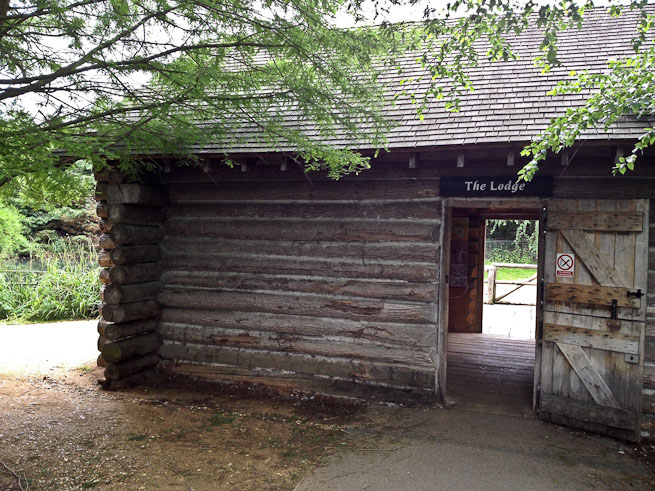
The cabin looks like a recent construction, is well built and inside hosts a few displays dedicated to the native people of the northern forests and the trappers of the fur trade era of the Hudson’s Bay Company.
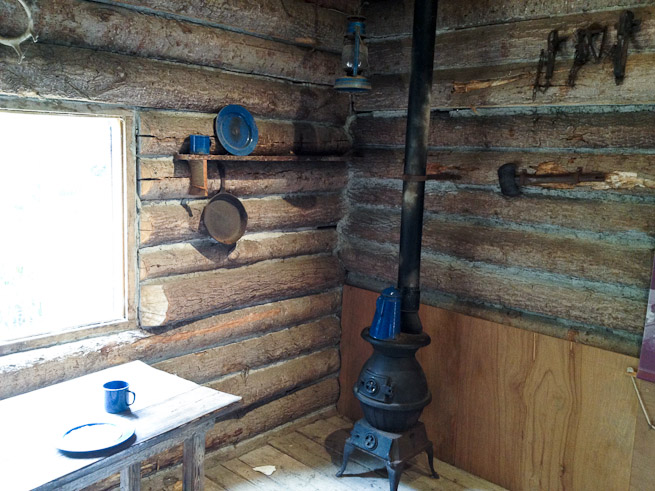
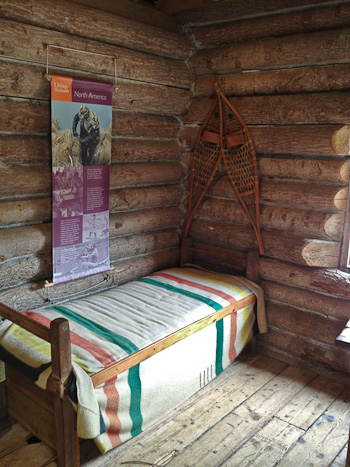
There is a mock up of a bed with Hudson’s Bay blankets, snow shoes on the wall, a double-bit axe, a musket and a selection of traps.
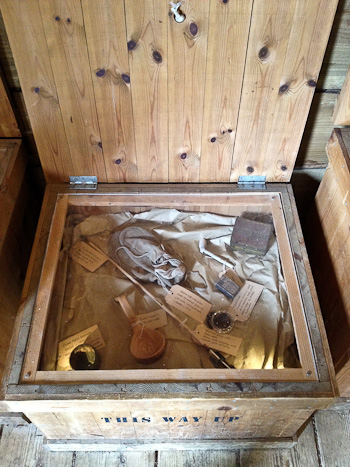
Best of all there is a little chest with crafts and artifacts from that time; Cree moose hide moccasins, a handmade arrow, an example of Native American basketry and a birch ladle.
All in all, this was a pleasant surprise and nice to see things that appeal to my bushcraft interests right in the heart of the city.
What unexpected places have you found bushcraft inspiration? Have you discovered a great display in a museum, wildlife park or heritage site? Let us know in the comments section below…

Barry Smith
Latest posts by Barry Smith (see all)
- There’s Something In The Air… - September 29, 2013
- Bushcraft Knife Choice For Children And Young People - April 24, 2013
- Bushcraft On A Budget: Improving The Swedish Army Snow Smock - January 22, 2013
Steve Bayley
The Pitt Rivers Museum in Oxford houses a fantastic anthropology collection including some interesting fire making equipment from around the world. There are other Bushcraft related items in there too. It is a fascinating museum and quirky with it. Bring a torch; it can be difficult to see into some of the packed display cases which are crowded into a rather dimly lit part of the building. Well worth a visit!
Terry Halls
I agree there, Steve- I am always telling people to go to Pitt Rivers and I must go again myself!
Ray Hutchinson
I think there is/was a display at the Oxford University Museum of Natural History, it had a selection of tools and some examples of fire making equipment. I was being dragged about by my nephew so I do not remember too much of what was on display.
Ray Hutchinson
Yes I was thinking about Pitts River too.
Steve Bayley
The Pitt Rivers collection is in the same building as the Natural History museum Ray, so we are thinking of the same place. I also seem to remember the Scott Polar Research Institute and Polar Museum in Cambridge being of interest although I’ve not been there for several years. There is an online facility for the some of the collections perhaps the most obvious being the Arctic Material Culture Collection; see http://www.spri.cam.ac.uk/museum/catalogue/armc/
Paul Kirtley
Hi Steve,
Yes, the Scott Polar Research Institute is still well worth a visit. Ian and I spent a good afternoon there earlier this year.
Best,
Paul
Wayland
Pitt Rivers is one of my favourite museums too but the anthropological collections in Oslo and Karasjok are pretty good too.
Barry
Steve, thanks for the tip on Pitt Rivers. Sounds like its worth a visit. Barry
Austin Lill
The British museum in London has a few gems in and when I visited Brighton museum a few years back, they had a lot of indigenous displays too.
Paul Kirtley
Agreed Austin, the British Museum has some lovely displays. I particularly like the Native American section with its wide cultural representation from Inuit crafts to Plains Indians clothing.
Favourites of mine are also the ancient Europe and Middle Eastern galleries on the upper floor as well as Africa on the lower floor. That said, when visiting the British Museum, I always get the feeling that I’m only seeing the tip of an iceberg. There is so much more that they could display on any one culture or period of history, yet don’t have the room.
A museum that didn’t have these restrictions and that I found particularly appealed to my interests, both in terms of African bushcraft and natural navigational techniques, was the The House of Wonders Museum of History & Culture of Zanzibar & the Swahili Coast, in Stone Town, Zanzibar.
I was somewhat aware of the history of the Swahili coast and trade routes between Zanzibar and the Arabian peninsular but this shed new light, increasing my understanding, particularly of old navigational techniques and use of trade winds.
Certainly too far for a day out from the UK but if you are ever in that part of the world, well worth a visit…
Par
Both Skansen and Jamtli — two Swedish open air museums — have some stuff that are bushcrafty. The birch bark and split log roofs on the old houses, the birch withys used for all kinds of things, the old self sufficient ways of doing things.
Paul Kirtley
Thanks for the heads-up Par 🙂
Hans
Also the Sápmi museum in Jokkmokk http://www.ajtte.com/ is very interesting and good.
Sadly I have not been there for years,
Paul Kirtley
Hey Hans, I really do need to visit that museum. Thanks for the reminder! 🙂
All the best,
Paul
Todd Monaghan
The Lewis and Clark display at The Magic House in Kirkwood, Missouri. Tents, canoes, compasses, maps…..
Paul Kirtley
Hey this sounds very interesting Todd. Would like to see it one day….
Tom Gold
Currently being inspired the writings of Horace Kephart particularly in terms of campcraft and outdoor cooking. What I like best about his work is that it came first hand from the ‘get it right or die’ school of pioneering and exploration that opened up the American continent.
You can take this hard earned outdoor technology straight from his words and diagrams and discover that it still works as well today as it did for the original ‘mountain men’ who Kephart encountered.
There is nothing contrived about his work, he didnt spend time distressing the fabric of his bedroll or artfully arranging feathers in his hat so that he could look more ‘bushcrafty’, he simply used the most effective and expedient means at his disposal and often the barest minimum of kit.