
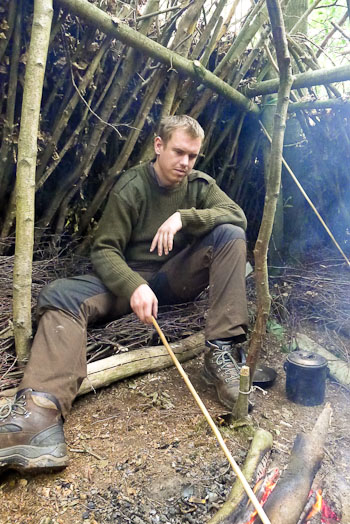
At first, learning bushcraft is about gaining fundamental knowledge and basic techniques, learning the most useful and widely-applicable elementary bushcraft skills. These bushcraft skills are largely aimed at addressing your basic needs – shelter, fire, water and food.
Here there is a substantial overlap with survival skills. Basic bushcraft skills are typically directly applicable without much material preparation. They are skills that can be applied immediately upon arrival in an environment without access to an established material economy or cycle. That is, you don’t need materials collected, hunted or prepared during a previous season in order to apply the technique right now.
The basic level of bushcraft skill is the stage at which you are most likely to be reliant upon equipment carried with you. This is both a physical and a psychological dependence.
Progressing Your Bushcraft Skills
As your skill level and knowledge of nature increases, you become more independent of the equipment you might take with you.
As you progress, the intermediate level of bushcraft skill is characterised by an ability to prioritise correctly, identify the appropriate natural resources and efficiently apply elementary bushcraft skills.
This progression is a result of practice, experience and attaining the correct mental attitude.

The confidence gained from being able to consistently apply basic skills at will also sets apart the intermediate-level student.
Elimination, not Accumulation.
“One does not accumulate but eliminate. It is not daily increase but daily decrease. The height of cultivation always runs to simplicity.” Bruce Lee
Learning at the intermediate level is characterised by a reduction in dependence upon pre-existing equipment and an increased ability to fashion useful items from natural materials.
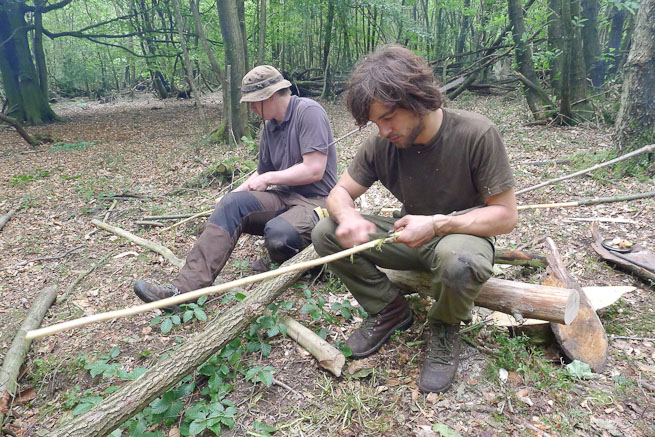
Some of this fabrication requires more prolonged preparation. It may also require a higher level of skill in certain areas (e.g. carving). For example, to fabricate a fishing net, you first have to manufacture equipment that allows you to make the net. You may also need to produce good quality, long-lasting natural cordage.
Increased Possibilities through Bushcraft
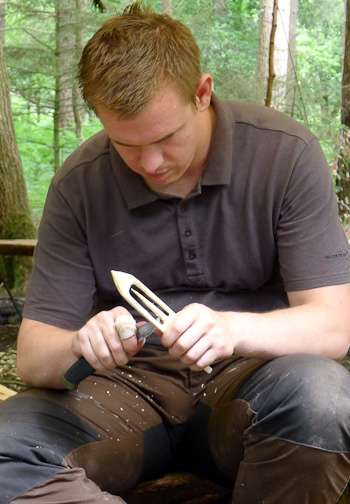
Increased bushcraft skill not only makes the production of particular items possible where it was previously beyond your abilities. Increased skill makes the production of basic items much quicker.
Thus the intermediate student of bushcraft has more time for other activities once the basics are covered. A beginner will take hours to carve a rudimentary spoon; an intermediate level student will produce a practical, well-proportioned and eminently useable utensil in a fraction of this time.
Intermediate students of bushcraft will also be establishing a broad and detailed knowledge of useful trees and plants in the environment in which they are studying. This knowledge should not be purely academic as illustrated by the statement “this plant can be used for X”; rather they should have experience of applying the knowledge – finding, gathering and processing.
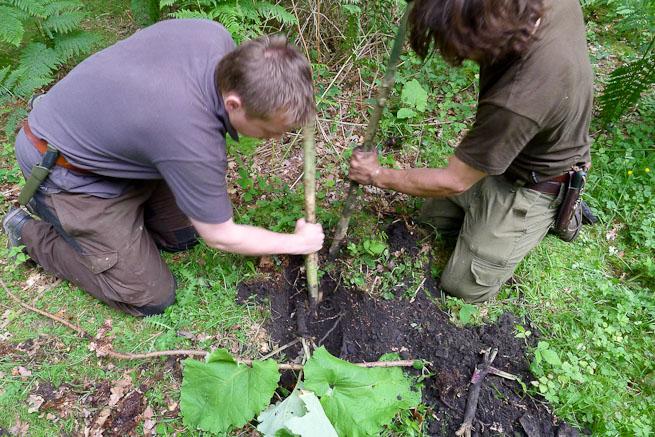
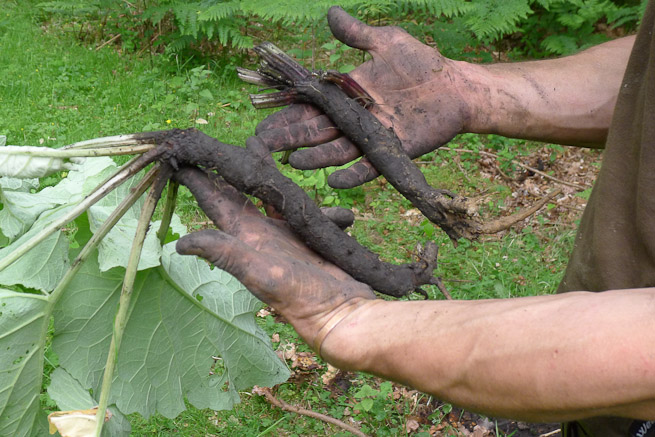
A broader knowledge and a greater level of experience allows the intermediate student more options, both in terms of addressing their immediate needs but also in establishing themselves for longer-term wilderness living.
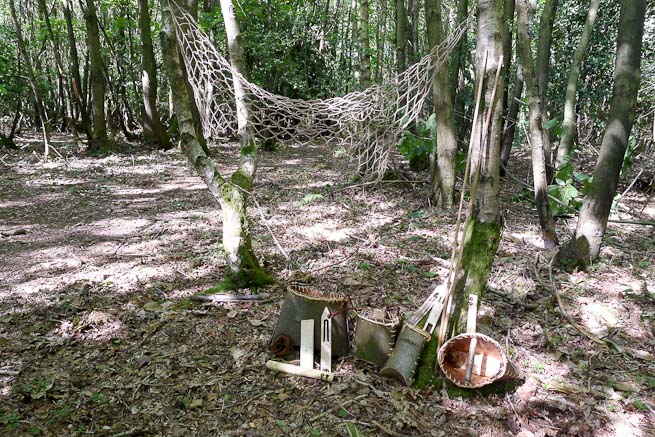
This is a key distinction: The intermediate student has the ability to move beyond basic survival, establishing a more certain foothold in an environment. They can then start producing more elaborate equipment which allows them to remain in the environment for an extended period, all the while eliminating dependence on much of their previously-necessary outdoor equipment.
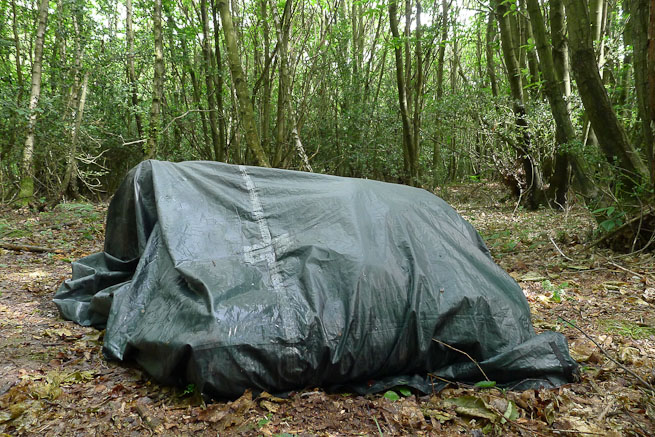
In addition they will have gained the experience and developed a mental attitude allowing them to cope with a greater dependence on themselves and nature.
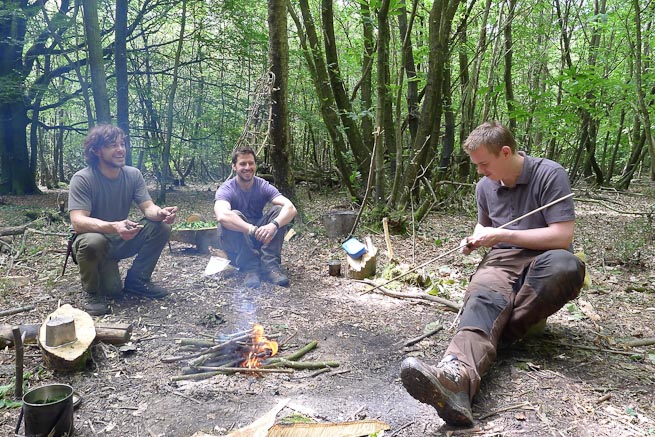
The intermediate student of bushcraft is, in fact, learning to stand on their own two feet amongst nature. The result is competence and confidence.


Latest posts by Paul Kirtley (see all)
- The Swedish Firesteel - January 5, 2023
- Kevin Callan and Paul Kirtley in Conversation - April 25, 2020
- Kevin Callan and Ray Goodwin in Conversation - April 18, 2020
Austin Lill
Looks great but with a young family I haven’t really got the scope to do an extended course, shorter ones are another matter! When are all of next years dates coming out by the way?
Paul Kirtley
Hi Austin! We’ll have some 2013 dates out later this summer. Watch this space… 🙂
All the best,
Paul
David
Hi Paul,
This is what I aspire to!
Going into the woods without a large pack full of kit and being able to cope.
It’s so easy to get into the mindset that you need all this modern day equipment!
Just got to go on some courses to learn how to do it.
David.
Paul Kirtley
Hi David,
Thanks for your comment. It’s certainly liberating to be able to do without much modern equipment. As you rightly point out, it’s a lot to do with mindset. Once you want to know how to do without, you are receptive to learning the skills and absorbing the knowledge which allows you to do it. These skills are not rocket-science, they just require you to put some time in learning them. Of course, you’ll get up the learning curve faster if someone shows you how and puts in place a framework for you to apply them yourself. This is essentially what our courses do. I hope you can make it onto one of them at some stage.
All the best,
Paul
Jack
Hi. I have been a student of bushcraft now for several years of my childhood, and next year i am hoping to attend a Frontier Bushcraft course. I have looked through both the elementary and intermediate courses, and i feel that i am confident with the majority of criteria on the elementary course (excluding friction fire). I have a fair bit of bushcraft and survival experience, but have not attended a course before, all my skills are self taught. I was wondering whether i would be able to attend the Intermediate course as my first course, rather than having to do the elementary, as i am more than confident with all basic bushcraft skills and several more advanced skills. Thank you,
Jack
Paul Kirtley
Hi Jack,
Thanks for getting in touch.
I’ll drop you an email.
Warm regards,
Paul
jim parr
enjoyed the presentation on bannock bread got to try it
jim
Paul Kirtley
Glad you liked it Jim.