
I always enjoy making canoe journeys in wild country. Particularly when you travel as a single tandem pair, or even solo, there is a feeling of isolation and giving yourself up to the wilderness. The canoe is quiet and has a natural pace to it. During canoeing expeditions you become part of the landscape you are travelling through. It’s always a real wilderness adventure.
You are very exposed, however, when travelling in the wilderness in a single canoe. Your canoe is both your means into, and out of, the wilderness. You are entirely dependent on your boat as a means of transport.
If you lose your canoe for whatever reason and end up on an isolated shore, you will then have to rely on your bushcraft and survival skills along with any equipment you may have on your person.
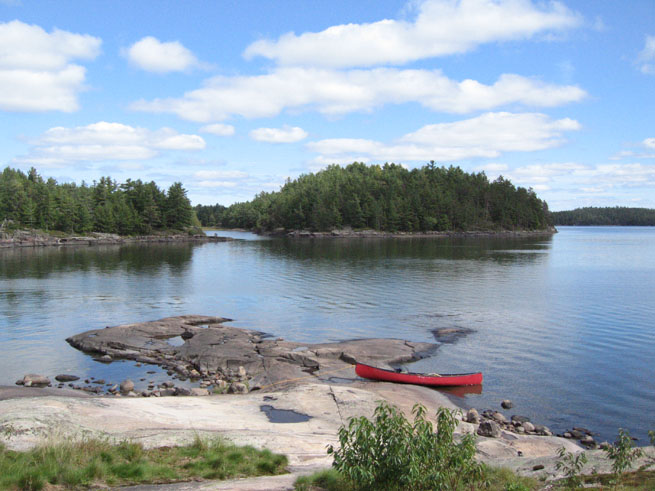
Comparing other modes of self-propelled wilderness travel, the risks of losing your main camping equipment and other supplies are different. When you hike there are times when there is the chance you might lose your backpack – river crossings are the most obvious circumstance – but there is more of a risk you’ll become separated from your camping equipment when travelling by canoe.
When you are hiking, you have the option of re-tracing your steps. If you are marooned after being separated from your canoe, however, there are likely to be no trails from where you are. There may not even be trails anywhere nearby. There could easily be tens of miles of dense forest between you and the nearest hunters trail or ATV track, never mind a road.
Don’t get lulled into a false sense of security by thinking there are likely to be other people around to spot you or raise the alarm. Take responsibility for yourself. Even in popular canoe camping areas, there are times of year when there is hardly anyone around. You can go literally days without seeing another canoe.
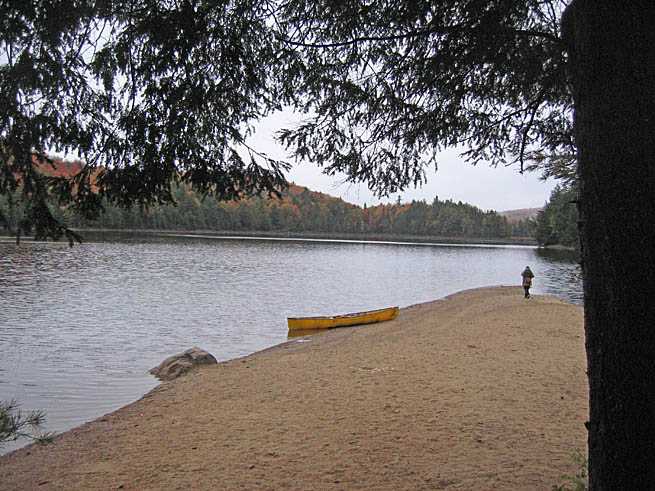
If you are taking only a day trip from a wilderness cottage or cabin, you can still travel many miles in a morning. You can be a long way away from anyone even in half a day. In this circumstance you will likely be travelling light, probably without camping equipment. You are then even more dependent on what little equipment you have with you.
So, the equipment you keep on your person while making a wilderness canoeing trip bears some serious consideration.
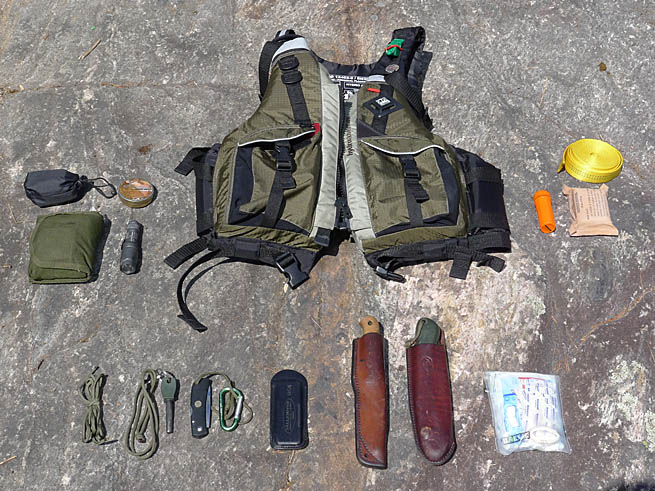
Below is a list of bushcraft and survival items I like to have on my person while canoeing in wilderness. Some of these items are used on a day-to-day basis during a wilderness canoe trip. I avoid doubling up wherever regular use will not diminish the item’s usefulness in a survival situation. Other survival equipment I carry for use only in a wilderness emergency.
You won’t be able to hire much of this equipment from a canoe outfitter and it’s unlikely you’ll be able to purchase all of the equipment you need in any single wilderness outfitter. It’s best to assemble your wilderness canoeing bushcraft and survival equipment ahead of time.
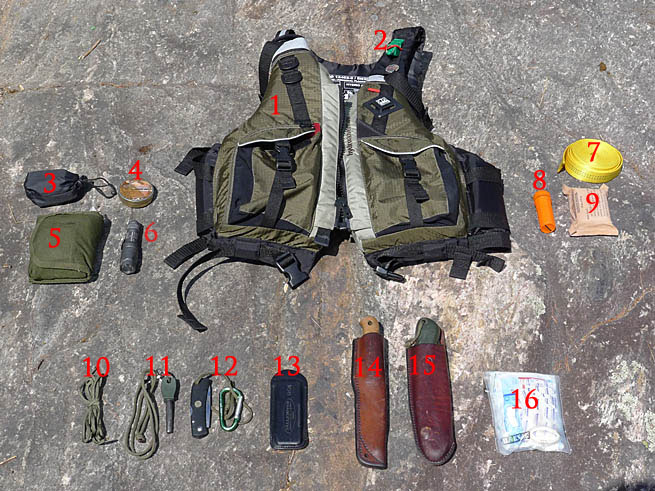
1. Buoyancy Aid (also known as a Personal Floatation Device, or PFD): A buoyancy aid is an important piece of personal survival equipment whilst canoeing under any circumstances. For wilderness canoeing expeditions, choosing a buoyancy aid with decent-sized pockets will allow you to stow survival kit in the buoyancy aid itself. Assuming you’re always wearing your buoyancy aid while on or near water, you’ll always have this survival equipment to hand. For more information on choosing a BA (PFD), please see ‘Canoeing’, by Ray Goodwin.
2. Whistle: You should have at least one very loud whistle on your person. The whistle in the picture is a Fox 40 whistle. Some people don’t like attaching a whistle to the outside of their buoyancy aid as it creates extra potential for snagging while in the water. An alternative would be to put it inside one of the buoyancy aid’s pockets. Nevertheless, you should make sure you have a whistle with you whenever you are making a journey in wild country. It is a very effective and efficient means of signalling for help.
Right-Hand Buoyancy Aid Pocket
The following items fit in the right-hand pocket of my buoyancy aid (personal floatation device):
3. Mosquito Head-Net: A mosquito head-net is an essential item on many canoe and camping trips. Biting insects can make your life a misery. At best they are irritating and at worst they can drive you to distraction. If you are using cutting tools or undertaking other tasks that require your full attention, it’s best if you are able to concentrate without being distracted by mosquitoes or other biting insects. A deep cut or other injury is always more serious when you are in remote country than when you are closer to medical care. Also, if you are distracted or in a rush to get away from a biting swarm, you are more likely to leave or lose important items of equipment.
4. Insect Repellent: For the same reasons as above, a portable tin, tube or similar of your favoured insect repellent can make life more bearable.
5. Fishing Kit: This is a compact yet effective fishing kit. It is what I take with me when I carry a travel fishing rod but it also functions very well on its own, without a rod. In addition to various hooks, jigs, lures, weights, spinners, etc., in this pouch I also keep a gill net and some snare wire. Gill nets are illegal in many jurisdictions and this is carried for emergency use only. The snare wire has multiple uses in addition to making snares.
The emphasis of this ‘food acquisition kit’ is very much on catching fish. The reasoning being based on the scenario of being stranded next to a lake or river. In the survival scenario that you were there for any great length of time, fishing would be a very likely source of sustenance. Remember all fresh water fish are edible. You’d also want to stay relatively close to the water most of the time; there you’d be much more easily spotted from the air than if you were under the tree canopy.
6. Flashlight or Torch: I find the Surefire ‘Outdoorsman’ flashlights excellent for wilderness use. They are reliable, no-compromise torches that perform very well – just the attributes you need if you are to depend on a piece of equipment. The brightness of these torches combined with the push-button switch at the back of the unit makes them a good signalling device too.
Moreover, the Surefire ‘Outdoorsman’ lamps have rubber O-rings which help keep water out of the torch. This is ideal if the torch is living in your buoyancy aid. Added to this, the model that I carry – the Outdoorsman E1L – runs for a good amount of time on a single CR123 lithium battery. I carry a couple of spare batteries taped together in a small plastic bag (not shown).
I’ve argued elsewhere why I choose a relatively expensive flashlight model but I’ve had plenty of torches and flashlights that have broken or failed on me and I know the value of a good one. We are so lucky to have such bright, lightweight, compact and tough hand-held illumination available these days.
Whenever I hear people argue for cheap torches, I gain a wry smile on my face and think of Bill Mason’s description of how, out of sheer frustration, he flattened a malfunctioning flashlight with the poll of his axe (I looked it up – it’s on page 55 of ‘Song of the Paddle’).
Left-Hand Buoyancy Aid Pocket
The following items fit in the left-hand pocket of my buoyancy aid (personal floatation device):
7. Tape: This isn’t a piece of survival equipment as such, although it could be put to various uses. It’s included in this list for completeness as it lives in the left-hand pocket of my buoyancy aid. I primarily use it for creating a bridle for the canoe. For more about how to do this see chapter 7, ‘Lining, Tracking and Poling’, of Ray Goodwin’s book.
8. Matches (in a waterproof container): While I always carry a Swedish Firesteel, or ‘fireflash’, (see #11 below), a match is sometimes more efficacious (I don’t get to use this word very often) in some circumstances. The humble match can light materials that can be difficult to light with sparks alone. But they must be kept dry. In the waterproof tub, I also pack some cotton wool. This stops the matches from rattling as well as being an extra aid to fire-lighting.
For more information on technique for lighting fires with matches, please see my article How to Light a Campfire with One Match.
9. Field Dressing: A large, absorbent military dressing, packed in a waterproof wrapper. This complements my small pocket first-aid kit or ‘cuts kit’ (see #16 below). Again, with this item, the waterproofing is important.
Not shown. Water Purification Tablets: I carry a compact packet or bottle of water purification tablets that are suitable for dealing with the pathogenic organisms found in the areas through which I travel. This often means iodine tablets. I recognise that Chlorine Dioxide is arguably a preferable treatment but because it has to be carried in two separate containers, it takes up too much room to fit in my buoyancy aid. A bottle of iodine tablets is more compact.
Trouser Pockets and Belt
The following items are stowed in my trouser pockets or on my belt. These are items are tend to need to have to hand on a day-to-day basis as well as being valuable assets in an emergency or survival situation:
10. Paracord: A hank of paracord can be invaluable. Genuine 550-lb breaking strain cord is best, not just because of its strength but also the multiple strands inside the protective outer sheath. It’s always worth having some in your pocket.
11. Swedish Firesteel, or ‘Fireflash’: These sparking devices are now well-known amongst outdoors people. They have no moving parts to break and are a very reliable means of lighting a fire as long as you have some medium which will catch a spark. The heat and the size of the sparks produced by a Swedish Firesteel means that you are able to light the widest range of materials with this sparking device. The manufacturer claims that you can get 12,000 strikes from one fireflash. Great for day-to-day usage, and great to have during a wilderness survival situation.
12. Folding Knife: While I carry a strong fixed-bladed knife on any serious wilderness expedition, I like to have a folding knife too. They are handy for day-to-day tasks and act as a back-up to your main knife. The model illustrated in the picture is Fallkniven TK4, which can also be used to create sparks with the Swedish Firesteel. A good alternative place to keep a folding knife is in a pocket of your buoyancy aid.
13. Sharpening Stone: A small, portable stone that can be used to sharpen both knives but that will still slip into a pocket is ideal. A diamond-ceramic combination is good because while the diamond face will remove metal from your blades relatively aggressively, the ceramic face removes it slowly but creates a finer edge. The two in combination thus allow you to re-sharpen then finely hone your edges. The model illustrated in the picture is Fjallkniven DC4 (inside its slipcase). These stones don’t require any lubrication – neither oil nor water – which adds to their ease of use in the field.
14. Belt Knife: I’ve emphasised belt here as this is where it should be. It should be kept on the outside of your clothing. Unless you have a separate rescue knife, this knife will act as your rescue knife and should be available to cut yourself free if you are entangled.
A good quality, well-made and well-tempered blade should not break under use in the wilderness. A strong knife of at least 4mm thick steel is recommended. It should have a full-tang for strength, a plain edge (serrations are unnecessary as your knife should be razor sharp) and be sharpened on one side only (that is nothing on the back of the knife).
The important point with a knife for wilderness canoeing is that it should not fall out of its sheath, even if you (and it) are upside down. Losing it while being tumbled around in moving water would be a grave loss in a wilderness setting.
15. Folding Saw: In addition to a strong knife, a folding saw should be carried. This is not only for typical tasks of bushcraft or campcraft but also again for safety and rescue. A folding saw will easily saw through wooden thwarts and other fittings in canoes if someone is trapped. Again, carry it in a way that is both easily accessible but also secure. I carry mine on my belt, alongside my knife.
16. Pocket First Aid Kit: This is the small pocket first-aid kit or ‘cuts kit’ that I describe here. Here the importance of the waterproof packet (an Aloksak) cannot be overemphasised. Any submersion will quickly ruin elastoplasts and other self-adhesive dressings as well as their packaging.
Organisation
As a final point it should be noted that most of the items in the buoyancy aid are only needed while on or near the water, or at night-time. All the items in my pockets could be needed at any time of day. This organisation is intentional. It means that everything naturally tends to be in the place it needs to be at the time it needs to be there. Keeping your kit organised shouldn’t be a constant struggle to get everything back in place.
I’d be interested to know your thoughts on this bushcraft and survival equipment or its organisation. I’m sure other readers would too. Please let us know in the comments below…

Latest posts by Paul Kirtley (see all)
- How to Make Dumplings for Campfire Stews - November 4, 2024
- Missinaibi Canoe Expedition Returns in 2026 - October 29, 2024
- Down the Spey With Paul and Ray - October 28, 2024
Rob Yates
Hi Paul
Nice article. For work or play, I carry very similar stuff in my PFD. In addition to this, I have wear a bum bag, with other things in like high energy bars, map & compass, knife sharpener, all in a large metal cup, + a beanie hat.
Enjoy you paddling
Rob
Paul Kirtley
Hi Rob
Thanks for your comment. That’s a good selection of extra gear.
I also carry a bum-bag (one of the Seal-Line roll-top types), containing rescue gear – karabiners, a couple of pulleys, a couple of slings – as well as a large hank of paracord (used for suspending food bags in bear country). I didn’t want to muddy the water (pun intended 🙂 ) in this article with rescue gear though.
I particularly like the idea of including a metal mug in your bum-bag.
Keep in touch.
Paul.
Nick
Hi Paul,
Good article as usual.
Looks like a well thought out set up. I’m planning some solo trips this year on and off water and it’s always interesting to see how others organise stuff.
Nick
Paul Kirtley
Hi Nick
Welcome and thanks for the comment.
I look forward to reading about your solo trips over at Skills For Wild Lives.
All the best,
Paul
Leon
Good choices – it’s easy to see you have thought out your gear. Here is a list of survival items I carry as part of my wardrobe: http://www.survivalcommonsense.com/2011/03/05/wardrobe-survival-kit/
Paul Kirtley
Hi Leon
Welcome and thanks for your comment.
Thanks also for the relevant link you posted. Your blog post made interesting reading. Thanks for sharing.
All the best,
Paul
Franke Schein
Nice kit–BUT where is the toilet paper? LOL!
Paul Kirtley
What an oversight!
🙂
Johan
From my personla experience I prefer to keep my PFD light and without pockets. The reason is when you fall in the water and will have to get back up in the canoe or swim ashore. Only thing I have on mine is a whistle on a string attached to the PFD.
One thing I miss isa small waterprrof pouch with some godd tinders, if you en up in the water and get to shore, you dont havce the time to look for tinders and in autumn hypothermia can come quick when being cold and wet. A fire helps, dry clothes helps even more. Drowning and hypothermia kills people every year even when you are close to civilisation.
Simple things like map and compass, can be a life savior and maybe a day or two walking out
But aside from kit, water confidence in cold water and be able to swim saved my life last year, but as first aid it needs to be refreshed every year.
Paul, again you have written a good article and I hope you continue your writing
Paul Kirtley
Hej Johan!
Thanks for sharing your thoughts.
Drowning is one of the biggest killers in the outdoors (alongside vehicles). People often underestimate the debilitating effect of cold water as well as the power of moving water. Being able to swim is, to me, an essential wilderness skill. A healthy respect for any water is also advisable.
Hypothermia is certainly always a significant risk in the great outdoors. Cold, wind and wet are the contributing environmental factors and after you’ve fallen out of your canoe and made it to shore, all three can easily be present. Particularly in Spring or Autumn/Fall.
Taking some emergency firelighting material is a good idea – barbeque fire-lighters are cheap and easy to light. The type that are like the more expensive, branded ‘Wet Fire’ fire-lighters also seem to be impervious to water.
Agreed – first aid and water safety should be refreshed every year.
It’s good to hear that your confidence and ability in water saved your life last year. What happened?
All the best,
Paul
Johan
It was just a simple daytrip in the local stream during a nice october day, like many other times. Paddled a light solo canoe that is perfect for small streams like this but a little unstable. The whole day worked perfect, eve got though some smaller rapids without any problem. In the end of the day and the dark was coming and I had about 10 min left until the pick up point. As I manovered around some tree´s I got caught on one and I ended up in the streaming ice cold water. I ended up under water and once I got and struggled to stay afloat and finally got hold of the canoe and it helped med to stay afloat so I could swin into shore and begin the climp up on the sand banks. One on shore I was so cold I was shaking uncontrollable. I just dressed off all the wet clothes and on with some dry spares. After that I was still shaking a lot so I started to collect materials for a fire and got quite quick a fire going to start warming my body up.
Now I was gaining coontrol of my body again and called home and said what has happened and that I needed pickup at the decided point in 10 min. After that it was just to pack up, take out the fire and a wuick clean up and paddle the rest of the way back. Once home it was a very long and very hot shower and some good drinks and food.
I was in many ways lucky that the weather was not worse, it could have been raining and made it much harder to get a fire going. I had people waiting for me, they knew were I was and when I was expected. I was wearing a PFD but, it´s there to help me keep afloat, it´s not a rescuewest. I gained a lot of weight because of the warm clothes I was wearing and when it got wet it got a lot heavier. The reason ilike a simple PFD without too much is that it makes it easier to move around, getting up in a canoe from the water or climp up on a sand bank for example.
I have trained this thing before, I have been in icecold water several times and know the importance of keeping calm and make good decisions. Things like this need to be practised and experienced. I more or less expect the same to happen during the winter when going out on the ice. The basic equipment wwill be about the same, spare clothes and means of making fire.
Dave
Great artical Paul, well wrote.
Cheers,
Dave.
Paul Kirtley
Cheers Dave,
I hope you enjoyed the pictures of your great country!
All the best,
Paul
Duane Yates
Hi Paul
Yet another very efficacious article! ( sorry couldn’t resist LOL )
A very interesting read and something to think carefully about even if you are not going far from civilisation. À friend of mine has a canoe which we will hopefully be using for some day trips in the summer so I will be following your advise.
Thanks again another great article 🙂
Take care
Duane.
Paul Kirtley
Thanks Duane
Glad you found the article, err, useful 😉
Enjoy your canoeing. I find after even a day on the water, I feel I’ve been away from ‘real life’ for much longer.
All the best,
Paul
Adrian
Very informative, thank you, we are looking to get into this side of Out door adventure soon, when our son can swim.
Just one query is there not a place on your kit for a throw line???
Paul Kirtley
Hi Adrian
Thanks for your comment and I’m glad to hear that you found the article informative.
My article was intended to address personal survival equipment for dealing with the general scenario of having been separated from your boat and stranded (on the shore) in wild country typified by the photographs in the article.
You are right to think that a throw-line should be part of the outfitting of the boat and part of your wilderness canoeing equipment.
Indeed you can read a blog about some of the Frontier Bushcraft team training in white water safety and rescue, including the use of throw lines here.
I hope this helps and good luck with your canoeing adventures!
All the best,
Paul
arnold crone
like this read very thoughtfull, first aid kits are very handy but in my expereance iv found that thay can run out to fast when thers a numtie in the camp.iv found some wild plants to used for healing soothing n steming.for cuts that keep on bleeding the razor srtop fungie does stop bleeding,selfheal prunella vulgaris for healing of wounds.sphagnum moss commonly called peat moss,used to draw out piosons from wounds.wild thyme antiseptic and preservative qualities.corn mint mentha arvensis a great cure all,also used to combat fleas,good for cooking to.collect the seeds then grow them in garden or widow box etc dry them then you can have a very light first aid kit ase you cant pick wild flowers it an illeagle [lol] theres no law aganst collecting seeds.so go sow yer seed [lol]there are meny plants that can be used but make sure you can identify them.
Nikolaus Legendre
Right up there with “Cliff Jacobsen” in my opinion. Well written, articulate, a good presentation.
Thank You.
Paul Kirtley
Hi Nikolaus,
Thanks for your comment. And your compliment – Cliff is someone I admire.
All the best,
Paul
Steve
Emergency Space Blanket
Zoe Playdon
Very nice article, Paul. I pretty much only paddle solo and have been given a couple of tips that I’ll pass on. First, when I’m working with ropes on the canoe – lining or whatever – then I’ve always got hanging round my neck a stainless steel Spyder knife with serrated, incurved edge, that opens with one hand – in case of a rope tangle on the wrist and a need for a very quick, safe, cut – more quickly than getting to my belt knife. Thanks to the crew at Llangollen for that one. Second, even when the canoe’s out of water and dragged up on the shore, it gets tied up too. Friends taking a late Autumn paddle on the Yukon River, in Canada, came on a river island with two people stranded: a sudden, violent gust of wind had tumbled their canoe right down the beach and into the distance. They had been there a week and were just at the stage of wondering if they could weave some kind of a coracle . . . Thanks to Jan Mackenzie for that tale.
Craig Fordham
Hi Paul, great article many thanks for posting it and as a fellow SRT it seems as if I carry a very similar kit to yourself, when it comes to fire lighting a few people seem to have brought this one up, as much as I hate to admit it I have recently purchased the Bear Grylls starter, if you shop around you can get it at a far more reasonable price then the original rrp 😉
what I like about it though is that it’s in a sealed waterproof tube with enough space for some cotton wool, I keep it on a lanyard around my neck and always feel happy that no matter what situation I end up in, I have the gear on me to start a fire and warm up. I’ve also recently started making up paracord bracelets and have even wrapped one around my paddle, so providing I don’t lose the paddle of course! I have a good 30 foot of cord at my disposal.
Looking forward to more of your articles, best wishes
Craig
Paul Kirtley
Hi Craig,
It’s good to hear that there is a lot of overlap with your kit.
I haven’t tried one of the Bear Grylls starters. Maybe I’ll give one a whirl…
Thanks for your comment and feedback.
All the best,
Paul
Stephen Walker
Hi Paul
Great article, and thought-provoking, especially if you are only ‘out for the day’ (you hope!).
I find you list pretty comprehensive, and would add my Web-Tex Surviva Pure water bottle. It goes everywhere with me if I am out of reach of ‘pure’ water. Also (now shoot me down in flames) I would carry my smartphone in its waterproof case.
Cheers
Steve
Paul Kirtley
Hi Steve,
Good to hear from you. I’m pleased you found the article thought provoking! 🙂
I think having some means of making water safe to drink (and storing it) makes sense if you are marooned in the wilderness. You do, however, need to make sure anything you attach to yourself will not hinder your ability to get out of the boat should you capsize. You also need to consider if there is a danger of things snagging on rocks or branches if you are in moving water.
As for your phone – sure if you have mobile reception but even on the French River, which is the location of our foundational Canadian canoe expedition and not particularly remote (as far as Canada goes), there is no mobile reception.
That said, you could at least use the screen to reflect sunlight at the search aircraft 🙂
Cheers,
Paul
Stephen Walker
Hi Paul
Hmm, take your point re snagging and getting out of the canoe.
As regards the phone, apart from signalling, mine will last at least a week before charging if I am careful. As it’s a smartphone I could write my memoirs whilst using the compass on it as there isn’t one in the kit, providing a GPS signal is available. It also has Viewranger maps, so I may discover my location to the nearest 10 metres. I could take some pictures with it, and of course I could use the front camera to check my hat was on straight 😉
Keep the articles coming.
Cheers
Steve
Paul Kirtley
You could also use a spirit-level app to make sure your shelter was built straight 🙂
Cheers,
Paul
Andy Thompsett
Great Article – really enjoyed it
I got my son a paracord bracelet and a belt ( both
From 550 paracord) for a Borneo expedition
Earlier this year – GREAT way to carry that “hank” of
Paracord without taking extra space , and of course
Ensuring you always have it on you
Try http://www.survivalstraps.com/
I also learned how to make them myself , instructions
On YouTube, materials on eBay!
Enjoy!
Andy
Paul Kirtley
Hi Andy,
Thanks for your comment. Sounds like your son is a lucky lad, having a great dad 🙂
Carrying some paracord is always prudent. If you haven’t seen it already, you’ll like the following article:
https://frontierbushcraft.com/2012/08/16/how-to-make-sure-always-have-paracord/
The only caveat I’d make with respect to water-based activities is that having paracord wrapped around a wrist or your neck does increase the likelihood of entanglement if you are in the water. Because paracord is, by its very nature, so strong, it is less likely to snap in such circumstances. Just something to bear in mind.
All the best,
Paul
Will
Regards to the phone idea: I am sure Paul said some time back about people just using phones as a GPS and compass tool only to find out their battery failed. Remember that a battery is not infinite in it’s charge. Some will only last 8 hours with constant use. Which is why when using it, is better to seek high ground, try and get a signal and call for help. If not then continue to walk out of the environment you are in.
One thing I have found was that a android phone magnetometer affected a Iphone magnetometer. So if this can affect another machine, what will the natural magnetic have on your own phone? People should always remember to not only rely upon technology but also have a back up, and a back up back up. If you lose your phone and compass, you need to start to rely upon natural compass bearings. Like which way is south if you can not see the sun, or use stars as a guide.
Aside from that, what do you think of the Maglite LED torch Paul. The new ones have strobe and can flash at full brightness SOS. I guess it is one of them things they have installed for such an occasion described in this manner. Plus it makes a good candle for looking at a map at night using the lower light setting.
Anyway, good post. Some things that are always needed when out and about, let alone in a canoe.
Paul Kirtley
Hi Will,
Thanks for your comment. “Some things that are always needed when out and about, let alone in a canoe.” – good point!
Yes, there were several news pieces I tweeted and shared on Facebook. They related to several parties of walkers who had become lost in the British hills, having been relying on a smartphone and its inbuilt navigational functionality to find their way.
Not long after these cases, the BMC released the following statement:
http://www.thebmc.co.uk/smartphone-apps-handle-with-care
As for the Maglite LED torch, I haven’t tried one yet. I have been a satisfied user of Surefire torches for a number of years. But a strobe feature is potentially very useful in an emergency situation, so I might have to check one out. I’ve also been trying out another brand of torch as a cheaper alternative to Surefire.
All the best,
Paul
bill jackson
Good list of gear, better than most.
I’ve spent three unplanned nights outside without a tent:
1) age 15, walked too far and it got dark in dense forest in the section of my route between trails.
2) Age 16, with experienced backpackers. My gear was wet so I spent the night in the rain under a poncho, in front of a fire.
3) Age 42, doing forestry work, found my return route blocked and darkness coming on. Rough country in the BC coast fjords, late November. Got a fire going, was well dressed, a long, boring night.
Since then I’ve spent a few nights out as trials, with the safety of my truck nearby. My experience so far:
I enthusiastically agree with the bug net. Those critters can drive a person to move around too much in the dark. In rough country the net is safety gear. If not needed, it’s a handy string bag.
What you need depends on your location and the season.
– a fire keeps you more busy than warm if you’re dressed appropriately. A fire built specifically to keep you warm needs a reflector. In summer it may be a hazard.
– When you lie down, your clothes compress and don’t keep you warm. Rain clothes don’t keep you dry when you’re lying down. The disposable bivy bags work ok for one night. You’ll be wet from condensed perspiration in the morning though.
– I’m able to rest in a squatted position under a poncho or with an emergency blanket to keep the rain off. I don’t sleep much but I rest adequately for the night. Takes some practise. So for me, the bare minimum is a disposable poncho and a half dozen pocket warmers.
Paul Russell
Hi Paul.
Interesting article, again.
I stumbled upon it while digressing from Ray’s new post on you’re blog.
I have a Delta Ranger PFD manufactured by Nookie that looks similar to you’re float coat.
Most of the pocket contents are much the same, however, I do have a hydration pouch on the back panel of mine, and not being a fan of bladders, I use the pouch to carry a cheep bright Orange sil-nylon poncho with a hank of cords. This is my emergency shelter, and funnily enough, also doubles as fairly good mobile rain protection 😉 The theory being, when wrapped correctly it will protect me from wind and rain while sitting on the back pad removed from the PFD “yes, I know this kills the buoyancy of the pad but in an emergency situation, its better than the environment killing me”.
Obviously, a poncho doubles as a small tarp for working under, a wind break, a wind and water proof wrap and even a stretcher if configured correctly.
I would have to admit though, that currently, it gets most use as sun shade while sitting on the bank drinking mugs of tea.
Its not often I comment on your articles as there is not much of value I can add to them, but I do enjoy them all.
Kind regards as always, PR.
Kurt
Good blog post, Paul!
I have a thought for your consideration: The Rule of Threes includes the need for shelter. I don’t see a HD garbage bag or two in there. I live in west central Alberta, Canada, where the water runs cold. For water excursions, some way to keep the wind off you while getting a fire lit and/or drying clothing is critical.
Thanks again, sir!
Kurt in Edson, AB
becks-berry.tumblr.com
The Importance Of On-line Sbobet Agents For Soccer Gambling
Gamers
A number of land brokers are providing real money gambling bets, but for the reason that existence of on-line soccer playing video games it
is now very straightforward to do soccer betting.
On-line playing makes it simple for playing players to wager safely and comfortably.
On-line Sbobet agent is essentially the most applicable choice for you, because the bettor immediately place a guess instantly with
the biggest betting firm in Asia, even on the earth. In this day and age, the
official Sbobet agent is right here to vary the minds of
the gamers that the net system may be performed effectively and practically.
The Sbobet playing firm began in 2004, Sbobet is underneath the PAGCOR license from the Philippine authorities which operates in Asia and also operates in Europe with
the Isle of Man license. As a result of the Sbobet company is an international site so it isn’t simple sufficient to supply
providers to customers who are in Indonesia, Sbobet cooperates with Depobola agents as its
agents to facilitate the gamers in processing account
creation and transactions.
The following info will summarize how important the presence of Sbobet online brokers, together
with the following:
– As a supplier of real cash on-line playing betting
Before online gambling, every player should go to an airport bookshop.
But for the reason that existence of an online soccer agent, conventional players have switched to online betting programs.
So the bettor can already place bets simply by means
of Sbobet agents.
– Supplies transaction safety and convenience
In Indonesia you cannot gamble, as a result of there are legal
guidelines which prohibit gambling. But the story is totally different should you play football
betting through Depobola brokers. Depobola will maintain the privateness
of members, all knowledge that you just register at Depobola is not going to be
misused or leaked. And Depobola additionally gives transactions transparently, where transactions
you make might be recorded into the system.
Giving the most effective Betting Market
For all players it is best to know that the Sbobet betting market
in the large match is one of the best in comparison with different gambling firms.
Also earlier than the match shall be given a schedule and in addition statistics of each match that
has been completed.
– Makes it easier for Gamers to Win Numerous Prizes
Official soccer brokers comparable to Depobola will make it easier for gamers to win tons of prizes which quantity to hundreds of millions of rupiah.
Even players who’re already very reliable, can profit
from jackpot bonuses as much as billions provided by Sbobet organizers.
Regardless that the wager money they put up isn’t too huge,
but because of the assist of the agent they will get
the chance to win the biggest jackpot prize.
– Gives a large collection of gambling games
As a member you can select freely what playing games can be found.
Many sorts of soccer betting options that you can play
however have many varieties resembling: Asian handicap, over / underneath,
1 x 2, odd / even, right rating, double probability, complete score and mix parlay.
Those are some facts concerning the importance of on-line Sbobet agents for bettors,
you must choose the very best and most trusted agent, one in all them
like Depobola.
Nigel Gregory
Hi Paul,
Have seen this a few times, but now it has become more relevant to my future, still o’d ing on YouTube vids, hoping everyone is safe and well,
Many thanks,
Nige.
Ps will my tarp keep me dry if I capsize?
☕☕☕